
Ad What? Ad Hominem
Have you ever been in a discussion—private or public/online—and experienced the other person resorting to personal attacks rather than addressing the issues? If so, you have experienced an ad hominem attack.
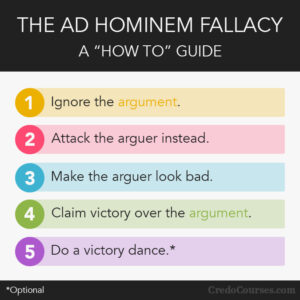
In conversations, discussions, and debates, an ad hominem fallacy occurs when someone resorts to name-calling, instead of argumentation. They seek to attack a person’s character, motives, or other attributes instead of engaging with the substance of the person’s actual argument.
Note: Some people distinguish between ad hominem fallacies and ad hominem attacks. I am using the two terms interchangeably. But here is how we might distinguish between them.
- An ad hominem fallacy might say, “Your argument is wrong because you are mean (or angry, or stupid, or self-centered).”
- An ad hominem attack communicates, “You’re wrong and you are mean (or angry, stupid, biased).” Or, simply ignoring the argument/topic and saying, “You’re mean, angry, stupid, and self-centered.”
2 Primary Types of Ad Hominem Attacks
There are several types of ad hominem fallacies, each with distinct characteristics. The two primary ones are:
- Abusive Ad Hominem: This involves directly insulting or attacking the other person’s character, intelligence, or personal traits in a false, immature attempt to discredit their argument.
- Circumstantial Ad Hominem: This type questions the other person’s motives or circumstances, suggesting their argument is invalid because of personal bias, affiliations, or self-interest.
Four Major Reasons People Resort to Ad Hominem Attacks
People resort to ad hominem attacks for several reasons, often driven by emotional and cognitive factors.
- Lack of Emotional Impulse Control: When discussions get heated, people may emotionally lash out personally due to insecurity, frustration, anger, a sense of humiliation, or a desire to dominate, bypassing reasoned arguments. This lack of emotional impulse control makes it harder to stick to logical arguments. It can feel emotionally satisfying to attack the other person directly. This emotional reaction can be seen as defensiveness, self-protection, and a need to assert one’s imagined superiority due to feeling inferior. When reason fails, the unreasonable person reaches for insults. Ad hominem attacks reveal much about the attacker’s own character, and little to nothing about the person being attacked.
- Lack of Strong, Substantive Arguments and Lack of Knowledge in the Field: When someone struggles to counter a person’s logic or evidence, attacking the person can feel like an easier way to undermine their credibility. Ad hominem attacks reveal more about the attacker’s inability to form a sound rebuttal, than about the target of the attack. A lack of preparation or knowledge can push individuals toward personal attacks when they cannot counter the argument logically. This is particularly evident in informal debates, where participants may not have the expertise in the field of discussion to engage substantively.
- Strategic Distraction: Ad hominem attacks can shift focus from a weak argument or lack of evidence, diverting attention to the other person’s supposed character or motives, in an attempt to confuse or sway the audience.
- Audience Appeal: Name-calling or personal attacks can resonate emotionally with an audience, especially in polarized settings, making them more persuasive than complex arguments, despite being fallacious. Thus, ad hominem attacks fall into the category of sinful people pleasing.
3 Wise Responses to Ad Hominem Attacks
First, keep your focus on facts and speaking the truth in love. Refuse to stoop to insults, mischaracterizations, and personal attacks.
“Do not repay anyone evil for evil. Be careful to do what is right in the eyes of everyone. If it is possible, as far as it depends on you, live at peace with everyone” (Romans 12:17-18). “Make sure that nobody pays back wrong for wrong, but always strive to do what is good for each other and for everyone else” (1 Thessalonians 5:15). “Do not repay evil with evil or insult with insult” (1 Peter 3:9).
Second, call out the verbally abusive ad hominem attacks. Sadly, when confronted about their slander, they will likely double-down, increasing their verbal abuse.
“Whoever heeds discipline shows the way to life, but whoever ignores correction leads others astray” (Proverbs 10:17). “Whoever loves discipline loves knowledge, but whoever hates correction is stupid” (Proverbs 12:1). “A fool spurns a parent’s discipline, but whoever heeds correction shows prudence” (Proverbs 15:4).
Third, if the verbal abuse continues, then discontinue the discussion. The other person has moved from mutual interaction to slander, gossip, and abuse.
“Whoever conceals hatred with lying lips and spreads slander is a fool” (Proverbs 10:18). “Warn a divisive person once, and then warn them a second time. After that, have nothing to do with them. You may be sure that such people are warped and sinful; they are self-condemned” (Titus 3:10-11).