
The Big Idea
God does not call us to fear the emotion of fear. He does not call us to eradicate fear. God designed fear as our “danger detector” and our “refuge reminder.” God created us with the capacity to fear in order to prompt us to take refuge in Him.
“When I am afraid, I put my trust in you” (Psalm 56:3).
Fear is our friendly and forceful reminder to take refuge in God, “our ever-present help in trouble” and danger.
March 4, 1933: “The Only Thing We Have to Fear…”
In his first inaugural address, on March 4, 1933, President Franklin Delano Roosevelt famously proclaimed, “So, first of all, let me assert my firm belief that the only thing we have to fear…is fear itself…”
So…should we fear…fear? Let me ask you some follow-up questions. Did you know that Roosevelt’s quote about fear is a part of a longer sentence? Do you have any idea what President Roosevelt said next in the rest of his sentence? Here it is in full:
“So, first of all, let me assert my firm belief that the only thing we have to fear is…fear itself — nameless, unreasoning, unjustified terror which paralyzes needed efforts to convert retreat into advance.”
Roosevelt was not demeaning the emotional capacity to discern danger. Roosevelt was not saying that our “danger meter” was dangerous. Roosevelt was not saying that our “danger detector” was hazardous, any more than we would say that our smoke detector is hazardous.
No. Roosevelt was recognizing the relationship of the emotional capacity of fear to our other capacities such as reason (“nameless, unreasoning, unjustified) and volition (“which paralyzes needed efforts…”). Roosevelt was recognizing that if our smoke detector gets stuck on that annoyingly loud beeping, screeching alarm, then we should check the battery.
Understanding Fear: Fear Is Our Friend
In the midst of fears, have you ever wondered or asked,
“God, why do I have to feel fear? Why does fear even exist! It’s so uncomfortable! Fear is so…scary!”
It’s a vital question. “Whence fear”? In today’s post, I provide two biblical answers…each communicating one message.
The two answers:
Fear is our danger detector.
Fear is our refuge reminder.
The one message:
Fear is our friend.
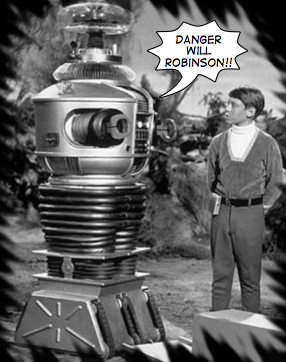
1. Fear Is Our Danger Detector: Fear Is a “Signal” Emotion—“Danger! Danger! Will Robinson!”
In the classic 60s show, Lost in Space, the Robot, who was young Will Robinson’s protective friend, would often cry out, “Danger! Danger! Will Robinson!” The Robot was Will’s danger detector, protector, and friend.
God created us with “an inner robot”!
Here’s the biblical purpose of fear:
God designed us with the emotional capacity to scan our environment, detect danger, react experientially, and respond prudently when our safety is threatened.
Wisdom literature repeatedly teaches this truth about fear’s purpose.
“The prudent (śāḵal) sees danger and hides himself, but the simple go on and suffer for it” (Proverbs 22:3; Proverbs 27:12—repeated twice in Proverbs for emphasis).
“One who is wise is cautious and turns away from evil, but a fool is reckless and careless” (Proverbs 14:16, ESV). “A wise person fears and turns away from evil, but a fool is reckless and overconfident” (Proverbs 14:16, The Complete Hebrew Bible).
Fear is our prudent friend—our wise, protective, caring friend. “Prudent” (śāḵal) includes our rational capacity to look upon, give attention to, and consider our environment with insight and comprehension. Prudence also includes our volitional capacity to act circumspectly and wisely. Prudence is vigilance. It is our capacity to scan our environment and determine to act accordingly.
The rational-volitional capacity of prudence works hand-in-hand with our emotional capacity of fear. Fear is a “signal emotion.”
First, fear receives signals from our environment (our situation, our circumstances). Initially, it does this in conjunction with our physical capacities. Our senses, our brain, our amygdala, they all receive sense impressions from our world and instantaneously, and often pre-consciously, respond.
Danger lurks. The hairs on our arm stand straight up.
Danger lurks. Our breathing gets rapid and shallow, our palms get clammy, we start to sweat, our body starts to panic.
Danger lurks. Our body goes into freight mode—fight, flight, freeze, faint, and/or fawn.
Since God designed us as embodied-souls, fear not only sends signals from our body; it also receives signals from our soul, from our relational-rational-volitional-emotional inner person. The prudent soul detects danger and communicates the need for safety.
In our fallen, evil, dangerous world, fear is our friend. Fear is our friendly, protective, warning Robot, crying out:
“Danger! Danger! Bob Kellemen!”
2. Fear Is Our Refuge Reminder: Fear Signals Our Desperate Need for God—“When I Am Afraid, I Put My Trust in You”
Our emotional capacity for fear also works hand-in-hand with our relational capacity. Fear alerts us for the need for protector—for our need for the Protector. Fear is our “refuge reminder.”
“When I am afraid, I put my trust in you” (Psalm 56:3).
“God is our refuge and strength, a very present help in trouble” (Psalm 46:1).
When our prudent vigilance meter detects danger, it alerts us physically and emotionally, and it reminds us that we can either be stuck in vigilant, self-protective mode, or we can turn to the One who is ever-vigilant.
“I call out to the Lord, and he answers me from his holy mountain. I lie down and sleep, yet I wake up in safety, for the Lord was watching over me” (Psalm 3:4-6).
The detection of danger is a God-given gift. But God never intended for the gift to stop there. God intends the gift of vigilance and fear detection to draw us back to the Gift-Giver—to Himself, our Refuge, Help, Protector, and Safey.
If we do not respond to our danger detector by taking refuge in God, then we experience “stuck vigilance” (see my booklet Anxiety for more about this). Our smoke detector constantly beeps and screeches. We remain on constant high alert. “Red alert! Shields up!” We watch over ourselves constantly, compulsively.
Fear, stuck fear, stuck vigilance, and stuck anxiety remind us, even drive and motivate us, to take refuge in God who is ever and always “watching over me.” I can sleep, because “He never slumbers or sleeps.”
Our fear alarm continually blares, and we continually turn to our Refuge.
“Be my rock of refuge, to which I may continually come; give the command to save me, for you are my rock and my fortress” (Psalm 71:3).
Our stuck anxiety alerts us constantly. We can constantly respond by facing our fears face-to-face with our protective Father. In every situation we continually “by prayer and petition, with thanksgiving, present our requests to God” (Philippians 4:6). Then, instead of guarding ourselves, the God of peace and the peace of God, “which transcends all understanding will guard our hearts and minds in Christ Jesus.”
We this second principle in mind (fear is our refuge reminder), let’s add to our description of the biblical purpose of fear:
God designed us with the emotional capacity to scan our environment, detect danger, react experientially, and respond prudently when our safety is threatened by taking refuge—with our final refuge being God Himself.
Fear and Our Embodied-Feelings
God gave us the capacity of fear to keep our eyes alert to danger. God also gave us the feelings of fear to motivate us to keep our eyes always alert to the Lord.
“I keep my eyes always on the Lord. With him at my right hand, I will not be shaken. Therefore my heart is glad and my tongue rejoices; my body also will rest secure” (Psalm 16:8-9).
As Psalm 16:8-9 indicates, the soul can help bring a level of calm to the body. As embodied-souls, we experience a complex interactive, interconnective relationship between body, brain, soul, mind. Of course, a level of calm does not mean the absence of intense embodied-emotions. Jesus, in His sinless response to His sinless emotions, still experienced intense bodily reactions.
“And being in anguish, he prayed more earnestly, and his sweat was like drops of blood falling to the ground” (Luke 22:44).
It is wise to keep Romans 8:18-27 in mind as we keep Psalm 16:8-9 in mind. The body’s reactions to feelings of fear may or may not totally subside. I say in Anxiety, that “the brain has a mind of its own.” Our body/brain is finite and fallen; our embodied-souls will groan until glory (Romans 8:18-27). Once our brain becomes habituated to stuck vigilance, it typically responds slowly to the progressive process of the renewed outer man entrusting itself to God as Guard. And, since this is a dangerous, evil world, fear should never be eradicated. But even our body’s continued alert can be another friendly reminder that “when I am afraid, I put my trust in You.”
When Our “Friend” Won’t Leave
Perhaps you have had a friend who overstayed their welcome. They were glued to your home and you were stuck with them.
Our “friend,” fear, can be like that.
In today’s post, I’ve been describing “creational fear.” God’s original design for our emotionality was “very good.” Our danger detector worked and our refuge reminder functioned properly.
However…we no longer live in a perfect world. Our world is fallen and it often falls on us. It is dangerously evil.
Our bodies are fallen—they groan with brokenness (Romans 8:18-27). Our brains are fallen. Fear gets stuck. Our fear alarm blares constantly.
In Anxiety, I called anxiety “stuck vigilance.” We scan, and scan, and scan forever. We might call fear “stuck prudence.” We detect danger…everywhere…all the time…even when realistically things are not dangerous. Our “friend,” fear, won’t leave.
And, because as Christians we are redeemed-but-not-yet-glorified, we can respond to fear in unhealthy and even in unholy ways. Instead of trusting in God and taking refuge in Christ, we can trust in ourselves and take refuge in our own self-protective schemes—many of which make matters even worse.
Today’s blog does not minimize the way fear in our fallen world can become a troubling, disturbing, and distressing emotion. When our fear alarm shrieks continuously, we become emotionally and physically exhausted. This distorted fear or disordered fear is what Roosevelt spoke about—paralyzing unreasoning terror.
A Current Illustration: Tsunami Warnings
A current world-wide illustration may help. On July 29, 2025, a magnitude 8.8 earthquake struck near Russia’s Kamchatka Peninsula. Numerous reports indicated that “the moment seismologists got word of the earthquake they felt an acute sense of anxiety.” The location can produce widespread, highly destructive tsunamis, as it did in 1952. In response, seismologists sent out a tsunami alert.
In God’s original design for our souls, He made us so that when life sends us an earthquake, we ought to feel “an acute sense of anxiety” and we ought to send out a tsunami alert. To not do that, as Proverbs 22:3; 27:12; and 14:16 teach us, is not wisdom, but naïve foolishness.
Because of the fall, fear and anxiety can become distorted in many ways. First, as Proverbs notes, we can detect danger and recklessly not take precautions. Second, our danger detector can detect danger when it is not there: this is “stuck vigilance” and “stuck prudence.” Third, when we detect danger, we can refuse to take refuge in God.
Thus, fear and anxiety, as our danger detectors and refuge reminders, are not sinful as designed by God. However, sin can mar the effective functioning of our “tsunami alert system.”
When We Perceive Danger; Perceive Our Safe Father
Even our broken alarm can serve a purpose. We don’t respond to fear by trying to eradicate our God-given capacity to detect danger. We don’t respond to fear by demonizing our God-given emotionality, or by denigrating our God-given danger detector and refuge reminder.
Many of us respond to fear by taking down our smoke detector. Picture it. We’re so afraid of fear, and so tired of our malfunctioning “fear smoke alarm” being stuck in screeching/beeping mode, that we remove the batteries and throw away our smoke detector!
We try to eliminate our God-given alarm system. We try to eradicate fear, rather than listening to the message fear sends and responding prudently. We frantically attempt to suppress all feelings of fear. Sometimes we even do this by “spiritualizing” our emotions and telling ourselves, and others, that faith eradicates all feelings of fear.
Instead of throwing away our fear detector, when fear stalks, we return to the original purpose of our fear detector—to remind us to take refuge in God. Instead of telling ourselves that faith eradicates fear, we allow fear to motivate us to cling to our Father.
Don’t flee fear; flee to your safe Father.
When we perceive danger; perceive our safe Father.
When we experience fear; experience God.
Fear bleats out incessantly, “Danger! Danger! Bob Kellemen!”
Scripture calls out repetitively, “Flee to your safe Father.”
“So, do not fear. For I am with you; I am your God. I will strengthen you and help you; I will uphold you with my righteous right hand” (Isaiah 41:10).
Ed Welch’s subtitle to his book, Fear Is Not Sin is correct: It Is a Call to Action. Specifically, fear is a call to relational action—to face our fear face-to-face with our Father, knowing Him and trusting Him.
Scripture comforts us by reminding us repeatedly, “Perceive and trust in your safe Father.”
“Look at the birds of the air; they do not sow or reap or store away in barns, and yet your heavenly Father feeds them. Are you not much more valuable than they? Can any one of you by worrying add a single hour to your life?” (Matthew 6:26-27).
“See how the flowers of the field grow. They do not labor or spin. Yet I tell you that not even Solomon in all his splendor was dressed like one of these. If that is how God clothes the grass of the field, which is here today and tomorrow is thrown into the fire, will he not much more clothe you” (Matthew 6:28-30).
“Do not be afraid, Abram. I am your shield, your very great reward” (Genesis 15:1).
When God whispers to His trembling child, “Fear not,” He is offering us comforting words of safety, refuge, and hope. When our fear alarms signals danger, we cling to God our Safety, Rock, and Refuge.
The “Mission” of Fear: Our Greatest Fear and Our Final Hope
Alexander Maclaren, in his commentary on 1 John 4:17-18, pictures the “mission of fear.”
“Fear, the apprehension of evil, has the same function in the moral world as pain has in the physical. It is a symptom, and is intended to bid us look for the remedy and the Physician. What is an alarm bell for but to rouse the sleepers, and to hurry them to the refuge?”
Our greatest fear, our final fear, is our fear of death and eternal separation from God (Hebrews 2:15). This fear of God’s final judgment is the context for John’s words that “perfect love drives out fear”—the fear of God’s judgment (1 John 4:17-18).
Maclaren explains that rather than trying to eradicate this fear of judgment, we should listen to “this wholesome, manly dread of certain discord with God.” In other words, apart from Christ we should fear judgment; we must fear God’s judgment. According to Maclaren, this God-given ultimate fear of judgment is meant “to arouse us to wakefulness and hasten us to run to Christ. The intention of fear is to direct us to Christ and His sacrifice.”
We do not have to experience the wrath of the Father when we bathe ourselves in the love of the Son. The fear of the Father is the greatest “signal” emotion—alerting us to our desperate need for Christ. When our souls fear separation from God, we don’t suppress that fear. Instead, we turn to our Soul Physician and Savior for the remedy.
Whether facing the greatest fear of all—eternal separation from God, or facing life’s daily fears, the biblical message is the same. Rather than fearing fear, we can respond to fear’s signals by seeing them as unpleasant yet “friendly reminders” of twin realities—our dangerous world and our Safe Savior.
“Life is dangerous, but God is our Refuge.”
“Life is unsafe, but God is Safe.”
“I can’t protect myself, but God is my Protector.”
“Danger lurks, but God is my Refuge.”
“Eternal danger lurks, but Christ is my eternal Savior.”
Fleeing to God for Safety
For passages on taking refuge in God, see, 40 Scripture Passages on Safety and Refuge in God: Home, Safe and Sound.
To learn more about how we can address anxiety-gone-wrong and fear-gone-wrong, check out Anxiety. In it, I offer a comprehensive biblical approach to addressing anxiety and fear relationally, spiritually, socially, rationally, volitionally, emotionally, physically, and situationally.
For a shortened version of that already brief material, see, Anxiety and Our Physical Bodies: God’s Care for Embodied-Souls.