
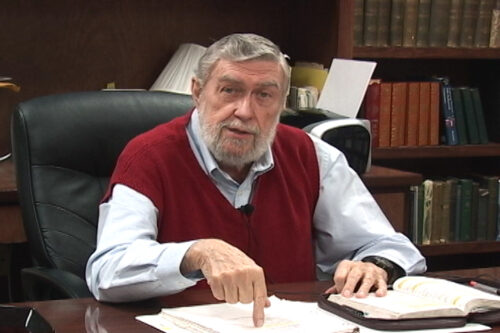
Adams on the Embodied-Soul
In February, 1992, Jay Adams gave a lecture on The Biblical Perspective on the Mind-Body Problem. That lecture was later published in a two-part series by The Journal of Biblical Ethics in Medicine. You can read Part One here. You can read Part Two here.
Adams delved into several interesting issues that remain extremely relevant now over thirty years later, including the embodied-soul, trauma, neuroscience, and physical interventions.
Area #1: Avoiding Dualistic Gnostic Thinking about the Body
Adams described in detail the Bible’s portrayal of the sacredness and goodness of the body. He spoke against Gnostic thinking—with its negative view of the body—creeping into the nouthetic counseling world.
“The body is respected in the Scriptures. Scripture repudiates the Gnostic idea that matter is evil. Gnosticism taught that spirit is good and matter is evil. Many harmful ideas came from this basic Gnostic teaching which early got a grip upon non-biblical thinkers…. The Bible knows nothing of the body being evil. Matter was created by God and it was created good. When God finished creating matter He looked upon creation and He said, ‘It’s good. It’s all very good.’ The idea that the body is evil, therefore, is not Christian. It is not a Biblical, concept” (Part One, 28).
Adams spoke about the unity of the body/soul—what I’ve called “the embodied-soul,” and what he calls “duplexity.”
“The union of ‘mind’ or spirit with the body forms a functioning unit oriented toward the material world” (Part One, 22).
“This union of body and spirit, rather than called ‘dichotomy,’ as some people call it (meaning ‘to cut into two’), I would rather call ‘duplexity,’ (which means two things folded together, two things brought together). Dichotomy speaks of taking the two apart, and we might call that what happens at death (you are dichotomized), but what you are now is a duplex person” (Part One, 23).
Adams built his understanding of embodied-souls (“duplexity”) from the Scripture and from his study of the neuroscience of his day. We now turn our attention to how Adams engaged with neuroscience findings about the brain/mind connection.
Area #2: On Being Neuroscience-Informed
In Part One, Adams spends 20% of his time discussing the implications of the neuroscience studies of his day. He begins by discussing how science has observed the “duplexity” of the brain/mind.
“It might be correct to say that the spirit has a mind as the body has a brain. I want to examine that statement a little further, but that’s probably an accurate statement. At any rate, this duplexity, functioning in man, this body/spirit thing called ‘soul,’ has been scientifically observed…” (Part One, 23, emphasis added).
For Adams, while science was not essential, neither was it incidental. It was important to Adams that his audience understand that neuroscience observed this duplexity, this brain/body, embodied-soul nature of humanity.
Adams further introduces this section, saying:
“I want to close with some quotations from the work of Penfield, and Echols [actually Eccles], and some others just to add that dimension to what we are saying here” (Part One, 23).
Before we explore Adams’s use of Penfield and Eccles, it will be helpful to understand more about who Penfield was.
Who Was Wilder Graves Penfield?
Wilder Graves Penfield was “a great explorer of psyche-soma-neuroscience.” He said of himself:
“Throughout my career, I was driven by the central question that has obsessed both scientists and philosophers for hundreds of years. Are mind and body one?”
Penfield believe that neuroscience was the pathway to understanding “man himself.”
“The nervous system was the great unexplored field—the undiscovered country in which the mystery of the mind of man might someday be explained!”
“The brain is the organ of destiny. It holds within its humming mechanism secrets that will determine the future of the human race.”
Penfield believed that the mind or soul could be explained by the nervous system!
As a precursor to modern neurological studies of the amygdala, cortex, and other specific sections and functions of the brain, and as a precursor to modern trauma theory, Penfield mapped “the brain and determine which functions of the body were controlled by which brain segment. He located the accumulated store of memory of past events and the emotions, sensations, and thoughts to which the events had given rise.” Some of the modern theories of the separate functions of the two cerebral hemispheres were built upon Penfield’s findings.
Penfield’s writings on the relationship between science and religion reflected his insight as a renowned scientist and dedicated humanist. (Quotes above taken from Penfield: A Great Explorer of Psyche-Soma-Neuroscience, and from Wilder Graves Penfield.)
In his book, The Mystery of the Mind: A Critical Study of Consciousness and the Human Brain, Penfield explored whether the mind can be explained by what we know about the brain. Is a person’s being determined by their body alone or by their mind and body as separate elements? In the Preface, Penfield addressed the age-old query about the brain/mind—about materialism (we are only brain) or dualism: we are brain/mind.
“Do brain-mechanics account for the mind? Can the mind be explained by what is now known about the brain? If not, which is the more reasonable of the two hypotheses: that man’s being is based upon one element or two?” (xiii).
In answering these questions, Penfield turned to science, not Scripture, to the scientist, not to the theologian (or nouthetic counselor).
“On the basis of either hypothesis, the nature of the mind remains, still, a mystery that science has not solved. But it is, I believe, a mystery that science will solve some day. In that day, I predict that true prophets will rejoice, for they will discover in the scientist a long-awaited ally in the search for Truth” (xiii, emphasis added).
Penfield was fascinated by the search for “a mechanism of the mind” contained in the brain (xii).
“In the past fifty years we have come to recognize an ever increasing number of semi-separable mechanisms within the human brain. They are sensory and motor. There are also mechanisms that may be called psychical, such as those of speech and of the memory of the past stream of consciousness, and mechanisms capable of automatic interpretation of present experience. There is in the brain an amazing automatic sensory and motor computer that utilizes the condition reflexes and there is a highest brain-mechanism that is most closely related to that activity that men have long referred to as consciousness, or the mind, or the spirit” (xii-xiii, emphasis added).
In The Author’s Afterthoughts, Penfield proposes that the evolutionary development of the brain could include the evolution of consciousness. That is, rather than God creating us as dust and divinity, as body and soul (Genesis 2:7), if we are dualistic beings of brain/mind, evolution would account for this. Penfield concludes that he leans toward a dualistic understanding, and again believes that science will one day provide proof of the nature of the evolution of the mind/brain relationship.
Interestingly, in his final paragraph, Penfield notes that he “was brought up in a Christian family.” However, his final words suggest that he no longer followed the faith. “Whether there is such a thing as communication between man and God and whether energy can come to the mind of man from an outside source after his death, is for each individual to decide for himself” (117).
What Did Jay Adams Say About Being Informed by Wilder Graves Penfield and John Eccles?
Adams spends several pages quoting from and interacting with the embodied-soul, mind-body neuroscience and philosophical views of secular-evolutionary researchers Penfield, Eccles, Popper, Kornhuber, and others. Adams’s primary purpose was to use their neuroscience research and philosophical ponderings to demonstrate scientifically Adams’s “duplex” view of humanity.
Penfield and Eccles taught an evolutionary scientific-philosophical dualism of brain/mind (body/soul) that rejected the materialistic view that we are only brain/body. Quoting Penfield, Adams writes:
“Here then, we have a dualism of object and subject, of brain and mind. It is no longer safe to view the mind as a computer, though the brain is indeed a computer of extraordinary refinement. But this computer has a programmer, and an operator who is using it as a tool of recall and of motor control” (quoted in Part One, 24).
Adams also quoted Eccles’s evolutionary neuroscience understanding of the embodied-soul.
“Echols [sic, Eccles] wrote, ‘I woke up in life, as it were, to find myself existing as an embodied self with this body and brain.’ That’s the way that he looked at it” (quoted in Part One, 24).
Clearly, Adams would not agree with everything that Penfield and Eccles wrote. However, Adams clearly valued their scientific-philosophical contributions to the issue of what it means to minister to the embodied-soul. In fact, immediately after quoting Penfield and Eccles, Adams concludes with an admonition that Christians seriously ponder their neuroscience/philosophical findings.
“As Christians I think we need to do serious thinking about these matters” (Part One, 24).
Think about this.
Jay Adams insisted that nouthetic counselors give serious thought to the findings of non-Christian, evolutionist, humanists who believed that, not through Scripture, but through neuroscience, the study of the nervous system/brain, and philosophy, we could finally explain the mysteries of the mind and soul.
Jay Adams was research-aware, philosophical thinking-aware, neuroscience-informed, and nervous system-informed. He valued the contributions that science, neuroscience, and philosophy could make to our understanding of and ministry to embodied-souls.
For a more extended historical discussion of how Adams and nouthetic counseling have been informed by extra-biblical information, see, INC: Informed-Nouthetic Counseling, which documents historically that nouthetic counseling has always been:
- BINC: Behaviorism-Informed Nouthetic Counseling
- NINC: Neuroscience-Informed Nouthetic Counseling
- PIINC: Physiological Intervention-Informed Nouthetic Counseling
- SINC: Science-Informed Nouthetic Counseling
- PINC: Psychology-Informed Nouthetic Counseling
- CGINC: Common Grace-Informed Nouthetic Counseling
- CBRINC: Co-Belligerent-Research-Informed Nouthetic Counseling
Area #3: Trauma and Suffering’s Impact on the Brain/Body and the Brain/Body’s Impact on the Mind/Soul
Adams’s theological anthropology of embodied-souls (“duplexity”), developed from Scripture and supported by neuroscience, had practical ramifications for how he viewed the impact of traumatic suffering on the brain/body. In turn, Adam’s theological anthropology significantly guided his understanding of the impaired brain’s impact on the mind.
Suffering: Trauma, the Brain, and the Body Keeping the Score
Adams taught that the body/brain responds to suffering by being habituated to react in certain ways. He explained that the sinful nature,
“…habituates the body, so that when adverse things happen (people say something critical, problematic situations develop, pressures come), the body is taught to respond habitually to those circumstances, in sinful ways. This sinful nature programs the body to respond wrongly” (Part One, 17, emphasis added).
Might we say that according to Jay Adams, the physical body/brain, influenced by the sin nature, keeps the score—by responding to trauma (“adverse things”) in habituated, programed ways?
Sin: The Brain/Body Role in Sin
Adams also explains the role of the brain in our surrender to sin.
“The brain is part of the body, and it is the brain that is programmed to see to it that the rest of the body responds sinfully” (Part One, 18, emphasis added).
According to Adams, the physical body/brain, influenced by the sin nature, encodes or trains or directs the person—the embodied-soul—toward sin. Thus, for Adams, of course it is within the lane of the nouthetic counselor to deal with the body/brain.
Because of Adams’s belief in our “duplexity,” he refused to minimize the importance of the physical brain. While some biblical counselors focus almost exclusively, or at least extensively, on the heart/inner man, Adams also emphasized the role of the brain/outer man.
“Yet the brain, which is part of that body, is more than a storage bin. It is an active filing and processing and controlling agent, that distorts, relates, molds, shapes data that are received according to its own biases, according to its points of view, according to its perspectives and dispositions, as well as according to its physical condition. And, it’s that physical condition of the members of the body (which includes brain) with which you are concerned” (Part One, 19, emphasis added).
Let’s recap what Adams is teaching about the body, suffering/trauma, and sin.
- The body/brain stores memories.
- The body/brain interprets memories.
- Suffering habituates and programs the body/brain (the brain keeps the score).
- The impaired body/brain impairs the mind/soul.
- The fallen brain is programmed to direct the embodied-soul toward sin.
- Biblical counselors and Christian physicians are concerned with physiological interventions that minister to the brain/body in order to minister to the mind/soul.
Area #4: The Embodied-Soul, Physiological Interventions, and Progressive Sanctification
Adams spoke a great deal about the relationship between the embodied-soul, physical interventions, and sanctification. He maintained a very earthy, real, practical sense of suffering, sin, and sanctification that involved the whole person—the embodied-soul.
The Brain/Body’s Impact on the Mind/Soul
Some biblical counselors so emphasize the heart/mind/inner man, that they seem to reject any ability of the body/brain/outer man to negatively impact the heart.
Adams would have none of that!
“The question: is the spirit so tied to the body in this duplex form in which we now live that it loses ability to relate to this world as the body becomes impaired? The answer is, obviously, ‘yes’” (Part Two, 3).
Adams elaborates:
“Though the spirit has an interest in doing things in this world, both learning from it by gathering data from it through the senses, and acting toward this world through the members of the body, it becomes difficult for the spirit, when the body is impaired, to do what it wants to do. It has a broken tool that it’s trying to use and finds that this becomes a hindrance. The spirit is hindered from working properly by this damaged tool, and the mind, therefore, does not always function even in full capacity, because, even internally, when a man thinks within himself, as he carries on a dialogue inside, this too depends on the interaction of spirit and body. Even within the mind then, let alone in the outward gathering of data and affecting of the world, bodily impairment causes a problem” (Part Two, 3).
This mirrors what Adams said earlier in Part One of his lecture:
“Now, when the body, the brain, or some other organ is impaired, the mind is affected, and we’ll get to what mind is in a little while. The body, we said, is like a damaged tool. That means it doesn’t function properly. And so, the mind cannot use, or use to the full, that impaired part of that body” (Part One, 20, emphasis added).
The damaged physical brain—the impaired body—hinders the working of the inner man—the mind/soul.
“When the body becomes impaired, the spirit does not function with reference to this world as it was intended to. That failure, of course, results from Adam’s sin, not necessarily from the individual’s sin. The mind functions poorly when it uses inaccurate or inadequate data. If your senses do not work well, then you gather inadequate data” (Part Two, 3).
After several more pages where he addresses the body/brain’s impact on the soul/mind, Adams double-downs on his insistence that, indeed, the physical body/brain can significantly hinder the functioning of the metaphysical soul/mind.
“Now we come to that time toward which everything has been moving in these lectures – some observations, some questions, some answers, and a few conjectures. If my spirit uses my body to gain access to and affect the physical world, through the senses and other bodily members, does physical injury or incapacity (short of death) impair or stop the spirit’s learning and functioning? The answer is that it would seem that the body may frustrate the spirit in this as well as in other ways. When the spirit is willing but the flesh (material side) is weak, Paul indicates, problems do arise” (Part Two, 6-7).
Again, Adams is clear: the fallen, finite, suffering, damaged, groaning (Romans 8:17-27) physical body/brain can incapacitate even the redeemed soul/mind.
Because of his understanding of the complex interrelationship and interaction between the body/brain and the soul/mind, Adams insists on the importance of physiological interventions in biblical counseling to aid progressive sanctification. As we will see, Adams specifically states that physical interventions “speed sanctification” (Part One, 20) and “allow for rehabituation and sanctification” (Part Two, 6).
Sanctification: The Brain/Body Role in Progressive Sanctification
Some biblical counselors so emphasize the heart/mind/inner man, that they seem to reject any focus on the role of physiological interventions for the body/embodied-soul.
Adams would have none of that!
In the context of the habituated body/brain impacting the redeemed soul/mind, Adams explains that sanctification must include the body/brain.
“So, then, at conversion, the human being is freed to serve God. That body, which had been held captive, and whose members had become slaves of sin, are now freed to become the slaves of Jesus Christ. Rehabituation enables the spirit to function properly toward the world. As one is rehabituated, sanctified more and more, learning to live according to the biblical alternatives and the ways of God, he becomes more efficient in the use of this body not only to evaluate things properly and to store the right kinds of memories – that he can call upon in making decisions in days to come -but also in making decisions right now to do the things that ought to be done” (Part Two, 6, emphasis added).
For Adams, “habituation, dehabituation (putting off the old, fallen, ingrained ways that the embodied-soul lives), and rehabituation (putting on the new, redeemed, restored ways that the embodied-soul lives) is very physical. What does this look like for Adams?
Physical Interventions “Speed Sanctification”
Adams’s audience included doctors, professors, philosophers, ethicists, and counselors. Speaking to them, Adams says, in no uncertain terms:
“Medical help may even speed sanctification (the process of growing out of sin into righteousness) in the sense that it may enable persons to do and think better than they might otherwise. It may even be part of an evangelistic tool so that the person may be enabled to hear and believe the gospel which he could not do prior to medical help” (Part One, 20).
Since the body is sacred, and the embodied-soul (“duplexity”) was created by God “very good,” Adams does not dichotomize between physical interventions and “spiritual” interventions. They overlap and interact. Both can legitimately “speed sanctification.” Both are spiritual, sacred, holy. In fact, we could say that all interventions are “physical-spiritual interventions,” or “psycho-physiological interventions.”
“Therefore, I urge you, brothers and sisters, in view of God’s mercy, to offer your bodies as a living sacrifice, holy and pleasing to God—this is your true and proper worship” (Romans 12:1).
Physical Interventions “Allow for Sanctification”
As we saw, Adams includes in his model of progressive sanctification, becoming “more efficient in the use of this body” (Part Two, 6). In this context of embodied sanctification, Adams insists that physical interventions allow for sanctification.
“But, the effects of sin on the body – a body that was injured before conversion – if they can be repaired by a physician will more fully allow for rehabituation and sanctification” (Part Two, 6, emphasis added).
Physical care can enhance spiritual growth.
Ministering to the Body Is a “Very Spiritual Activity”
Adams further asserts that ministry to bodies is a spiritual activity.
“Your job is not merely repairing bodies; it is enabling the spirit to work with and through a body so that God’s will can be done, so that the things of God can be accomplished by that body. You, therefore, are involved in a very spiritual activity” (Part Two, 6).
Enhancing the Body’s Function Enhances “Spiritual Activity”
In this same context of embodied sanctification, Adams teaches that:
“Bodily parts, impaired, worn, dulled, broken are ineffective tools of the spirit. Therefore, medical efforts that enhance bodily function make greater spiritual activity possible” (Part Two, 7).
Pastors, Elders, and Counselors Are Soul Physicians of Embodied-Souls
Some might mistake what Adams is saying as limited to physicians of the body. Some might mistakenly claim that Adams is saying that soul physicians ignore the body.
Not true.
Adams immediately begins a long exegetical-pastoral discussion of James 5:14 by contending that every Christian must do everything in their power to care for their body if we are going to serve Jesus.
“If we want to be fully capable of doing what God wants us to do, we must do everything we can to bring this body up to snuff so that through it we can serve Jesus Christ as well as possible” (Part Two, 7, emphasis added).
Adams follows this up with his discussion of the true meaning of James 5:14 (“Is anyone among you sick? Let them call the elders of the church to pray over them and anoint them with oil in the name of the Lord”).
“That means James 5 must be taken seriously. People have wrong ideas about what is taught in James 5” (Part Two, 7).
Adams explains that “anointing them with oil” is medicinal. It is a physical intervention.
“People today have made a ceremony out of what was medicine. That passage is not talking about ceremonial anointing at all” (Part Two, 7, emphasis added).
Adams backs up his claim with a lexical study of the phrase “anoint them with oil.”
“The word he used is ale ipho. Ale ipho is a word used by Hippocrates and all the old Greek physicians. It meant ‘to rub or smear.’ It depicts anything but a ceremonial anointing! It was used of rubbing down Greek athletes. Oil and wine, of course, were the two mediums that were used to rub medicinal herbs into a person’s body. That’s what James is talking about. Greeks even took oil baths.
The elders would administer medicine, just as they would pray and they would seek to elicit a confession if there was sin involved in this problem. Sin wasn’t always involved, but if it was, confession should accompany prayer and medicine.
So, at an early date then medicine had a relationship to the person, and he was obligated to do whatever he could do to bring his body into shape where he could serve Jesus Christ more fully” (Part Two, 7-8, emphasis added).
According to Jay Adams, pastors/elders were to be soul physicians of embodied-souls, administering the medical knowledge of their day and providing physical interventions to address the needs of the physical body so people could serve Christ more fully.
The Physical Is the Biblical Counselor’s Biblical Lane
In The Christian Counselor’s Manual, Adams addresses the specific issue of what he called “the organic/nonorganic problem” (437). His writings there dovetail strikingly with what we have been exploring from The Biblical Perspective on the Mind-Body Problem.
There are some biblical counseling leaders today who insist that biblical counselors stay in their lane by addressing the soul and eschewing matters of the body.
Adams would have none of that! It was not Adams’s conviction. Using James 5, as we saw him do earlier, Adams writes,
“James 5:14-16, for instance puts the organized church squarely in the business of dealing with organic illness” (438).
“Pastors should, for instance, (a la James 5:14 and 1 Timothy 5:23) urge medical treatment upon members as a biblical principle” (438).
Adams is adamant about the nature of comprehensive embodied-soul care:
“Pastoral care is ongoing and total. It is to be seen as extending over the body” (438, emphasis in the original).
Adams insists that the biblical counselor must be physiologically-informed.
“He will strive always to work from this biblical presupposition in ways that are consistent with it. He should take the time and trouble, therefore, to study the fundamental functions of the human body” (438–439).
In this quote, Adams is not talking only about being “medically-informed.” In a footnote to this quote, Adams writes,
“An interesting book dealing with psychosomatics is John Schindler, How to Live 365 Days a Year, op cit. Chapter 4 is of particular interest. Because Schindler does not write from a Christian perspective, much that he writes must be rejected (e.g., weakening sin to immaturity; seeing education and training as the answer rather than salvation). Yet his comments on the relationship of emotion to body are useful” (439).
Though Schindler was an M.D., his book focused not on medicine, but on self-help. The book blurb states,
“One of the great self-help books of all time, How to Live 365 Days a Year has sold more than 1 million copies and has been translated into 13 languages. Author John A. Schindler, M.D. introduced the powerful concept of EII, or “emotionally induced illness…. Topics include achieving emotional satisfaction, attaining sexual maturity, dealing with stress in the workplace, and meeting the challenge of the aging years.”
Even with this very secular book, even with Adams’s warning that much must be rejected, Adams still was “EII-informed.” Adams still said, “Yet his comments on the relationship of emotion to the body are useful.” Adams could and did attempt to “redeem” and use secular self-help information.
Based upon his biblical understanding of embodied-souls, Adams declares that the biblical counselor’s work constantly involves the organic dimension.
“That the body affects the soul and the soul the body in so many obvious, as well as subtle, ways is a fact that the Christian counselor must always remember. His work, therefore, constantly involves the organic dimension” (438–439).
Though respecting the role of the physician of the body, Adams demands that biblical counselors fulfill their scriptural calling of being soul physicians of embodied-souls.
Biblical counselors “can never shirk their responsibility for dealing with ethical matters of bodily use and abuse, nor can they allow physicians unhampered freedom to advise Christians in ways that tend to ignore or exclude this [embodied-soul] dimension” (438).
Adams specifically rejects the simplistic notion that counselors care for the soul and physicians care for the body. The biblical truth of embodied-souls led Adams to a much more nuanced, robust, and complex approach.
“These problems [of trying to divide body and soul] cannot be solved either by Skinnerian reductionism: man is only an animal (all is organic), or on the other hand by simplistic categorization: the nonorganic is the province of the pastor; the organic is the province of the physician” (438, emphasis in the original).
Clearly, for Adams, it is simplistic to say the pastor deals with the soul; the doctor deals with the body. Instead, for Adams, the pastor ministers to the whole person—to embodied souls. Or, as I say it frequently:
We are soul physicians of embodied-souls.
Area #5: Nouthetic Counseling, Sleep Studies, and Counsel About Sleep
In What About Nouthetic Counseling? (1976), Adams specifically mentions the importance of secular sleep studies as one of the particular areas that he found helpful in his ministry as a nouthetic counselor.
“I have profited greatly, for instance, from the results of the work done at the Harvard sleep labs (and elsewhere). This sleep study I consider to be a valid and worthwhile enterprise for psychology” (31).
Later in the same book, Adams discusses how nouthetic counselors address with counselees the issue of sleep—including suggesting ten specific physiological interventions.
“Question: You say a lot about the possible significance of sleep loss. Suppose sleep loss is important. What do I do to get to sleep when I find myself having difficulty doing so?” (61).
“Answer: This is a very important question. First, before I answer that one for you, let me review briefly what I have been saying about sleep loss. The Scriptures are clear that we must not do anything that injures our bodies (cf. I Cor. 6:15, 19). Christians have an additional reason to care for the body. Paul says that the Christian’s body is the temple of the Holy Spirit. Therefore, significant sleep loss becomes an issue of importance, if loss of sleep does, in fact, injure the body. Sleep loss studies show that it does (cf. Segal and Luce: Sleep and Insomnia)” (61).
Notice:
- Adams values secular sleep studies.
- Adams “says a lot about sleep and sleep loss.”
- Adams views addressing sleep loss in nouthetic counseling to be “a very important question.”
- Adams links sleep loss to the Bible’s teaching about the spirituality of the body.
- Adams supports his view on sleep loss with a clinically-informed, science-informed sleep loss study.
Adams then specifically insists that nouthetic counselors must know how to counsel people about the physical issue of sleep and sleep loss.
“So it is important to know how to tell the counselee to find sleep when it tends to elude him. The following factors may be advised:” (61).
Adams then outlines ten specific words of counsel that nouthetic counselors should give counselees about the physical intervention of sleep (61-62). These include what Adams considered to be evidence-based, clinically-informed content that nouthetic counselors should be aware of and share with counselees, such as, “Drink some milk before retiring. There is some evidence that milk contains chemical elements that help you to sleep” (62).
Adams’s list includes other folk wisdom, case wisdom, and basic common sense advice such as, exercising before going to bed, “don’t watch TV when you ought to be sleeping” (62), do a hard day’s work, and “take a relaxing hot shower” (62). Adams’s counsel also includes advice sure to be an encouragement to many, “sexual relations leading to orgasm (in marriage) helps” (62).
Adams then summarizes how this connects to nouthetic counseling.
“All or some of these factors will apply to each counselee who is having sleep problems. Often counselees need instruction and suggestions. Persons who have followed these instructions report that their sleep problems evaporate quickly” (62).
According to Adams, counselees need nouthetic instruction that offers specific physiological interventions.
Area #6: Adams on the Nervous System and Nouthetic Counseling
“The Nervous System Corresponds to the Nouthetic Approach”
On pages 96-97 of Competent to Counsel, Adams uses his understanding of 1970s neuroscience (“the nervous system”) to say: “The Nervous System Corresponds to the Nouthetic Approach” (96/Header).
Adams proposes that there are two sides to the human nervous system. One side is emotional and involuntary. The other side is associated with problem-solving and voluntary action and has to do with behavior (Competent to Counsel, 96).
“Something might be said about the human nervous system with respect to behavior and feeling in counseling. There are basically two sides to this system. One side is emotional and involuntary. The other side, associated with problem-solving and voluntary action has to do with behavior. The importance of this fact is that it is in the client’s behavior that changes can be made directly, because behavior, in contrast to emotion, is controlled by the voluntary, not the involuntary side of man. Emotional states flow secondarily from the behavioral or the voluntary system. The former involves the involuntary control of visceral and vascular emotional responses, whereas the latter involves action responses by the skeletal musculature. Communication between both the nervous systems must be supplied by sensory pathways of the central system. There is a close relationship or a connection between the two so that they can’t really be divided as precisely as one might on paper” (Competent to Counsel, 96-97).
Then Adams concludes with this summary implication for nouthetic counseling from his understanding of 1970s neuroscience/nervous system studies:
“While there is no direct voluntary access to the emotions, the emotions can be reached indirectly through the voluntary system, because extensive fiber overlappings in the cortex allow unified correlation of the two systems. Voluntary behavioral alterations will lead to involuntary emotional changes. It is important to understand, therefore, that feelings flow from actions” (Competent to Counsel, 97).
What Is Most Intriguing
Whether Adams’s conclusion and application of 1970s neuroscience were totally accurate or not, could be debated, then and now. But here’s what is most intriguing:
From the start of the modern nouthetic counseling movement, the founder, Jay Adams, at the very least used “nervous system studies” or “neuroscience” as illustrative and supportive of his nouthetic model of counseling. Adams used these studies at least in a catalytic way, if not more. Adams was neuroscience-informed.
Adams does not cite footnotes for his views on pages 96-97. Elsewhere in Competent to Counsel, Adams cites many footnotes related to other topics. Adams does not make any statement on pages 96-97 about any limitations of the scientific method or any potential biases. Earlier in the book, Adams does share his perspective on science, the Bible, and counseling:
“I do not wish to disregard science, but rather I welcome it as a useful adjunct for the purposes of illustrating, filling in generalizations with specifics, and challenging wrong human interpretations of Scripture, thereby forcing the student to restudy the Scriptures” (Competent to Counsel, p. xxi).
Adams, Mowrer, the Nervous System, and Informed Nouthetic Counseling
While Adams did not cite any footnotes for his views on pages 96-97 of Competent to Counsel, much of the wording overlaps in many ways, and at times is nearly identical to, O. Hobart Mowrer’s writings in Learning Theory and Personality Dynamics (published in 1950). On pages 236-245, Mowrer supports his “two-factor learning theory” through a description of the “two distinct nervous systems” (238).
Like Adams, Mowrer, twenty years earlier, described two sides to the nervous system. One side is the autonomic nervous system which mediates the emotional (visceral and vascular) responses. These visceral, vascular, emotional responses “are beyond direct control” (238). The other part of the nervous systems, according to Mowrer, is the central nervous system, which mediates behavior and which may be brought under voluntary control through habit/habituation (238).
Also like Adams, Mowrer, twenty years earlier, described the extensive fiber overlapping in the cortex. Mowrer quotes Fulton saying, “In the cortex there is extensive overlapping between autonomic and somatic motor representation, making possible unified correlation between the reactions of the two systems” (245). (Note: In 1938/1943, Oxford Press, published J. F. Fulton’s book, Physiology of the Nervous System, from which Mowrer quotes, from which Adams borrows.)
Given the almost word-for-word similarity between Mowrer’s description and Adams’s description, it is clear that Adams incorporated or integrated Mowrer’s understanding into his nouthetic counseling model. Learn more about Mowrer and Adams in: Meet the Man Who Influenced the Earlier Nouthetic Counseling Movement: O. Hobart Mowrer.
More on Adams and Informed Nouthetic Counseling
For how nouthetic counseling has always been informed by extra-biblical information, read: INC: Informed Nouthetic Counseling.
For more about how Adams used the neuroscience of his day to support the foundational aspects of his nouthetic counseling model. See: Jay Adams, Nouthetic Counseling, and Neuroscience.
To learn about how Adams and other nouthetic biblical counseling leaders engage with secular psychology, read: 6 Words Describing What Jay Adams and Nouthetic Counseling Do with Secular Psychology.
To learn more about very specific ways that Jay Adams used secular sleep studies in his counseling with people, see, A Little Post About Little Sleep. Adams not only addressed embodied-soul physiological interventions, he also used research from secular sources in his specific counsel.
As noted above, to learn much more about Mowrer and Adams in: Meet the Man Who Influenced the Earlier Nouthetic Counseling Movement: O. Hobart Mowrer.
To consider biblical, theological, and historical (church history) support for embodied ministry, see: Physiological Interventions and Relief-Oriented Care for the Embodied-Soul in Biblical Counseling.
For additional, detailed primary source documentation of whole person care—including the provision of physiological interventions for immediate relief—see these following four posts:
Richard Baxter on Depression, Scrupulosity (OCD), and the Embodied-Soul: Baxter ministered to the whole person, including prescribing pastoral counsel that included physiological interventions—relief-oriented care and counseling.
6 Lessons from a Depressed Puritan Pastor: Timothy Rogers: Rogers ministered to the whole person, including prescribing pastoral counsel that included physiological interventions—relief-oriented care and counseling.
Spurgeon’s Depression…And His Body/Brain/Embodied-Soul: Spurgeon ministered to the whole person, including prescribing pastoral counsel that included physiological interventions—relief-oriented care and counseling.
When a Biblical Counselor Battles Depression: Robert Somerville: Somerville, in his own life, and in his counsel from his book about his own depression, ministered to the whole person, including prescribing pastoral counsel that included physiological interventions—relief-oriented care and counseling for the embodied-soul.

Does Adams make a religious medical distinction when it comes to anointing with oil? Can it not be both an act of action in church that has medicinal value?
Why push the distinction?
I was never in a church that anointed and prayed for the sick until I was in my thirties. All such behavior had supposedly ceased.
The answer is also focused on the whole person. “Their sins will be forgiven and they will be encouraged emotionally.” (My paraphrase)
I have believed and acted upon similar ideas for decades.
At leasts in this particular talk, he does not make it both/and. That is typical of Jay who is more an either/or thinker than a both/and. I had never heard that interpretation of the passage until I read it in this article. It would be interesting to research what other theologians, scholars, and commentators say.
Bob,
I interacted with Jay at two conferences in the 1970s, and he seemed to be at a very different place than this article suggests in terms of working with the whole person. He was quite confrontational with us on several issues and not open to discussing them with us very much. I recall Siang Yang Tan doing his best to initiate a dialogue, but with little success.
I was just beginning my career at that time, and I concluded that he had little to offer me in terms of whole-person ideas as you present them.